
Our Best Work.
Review of one of Thinkers50 Top 10 Management Books of 2026.

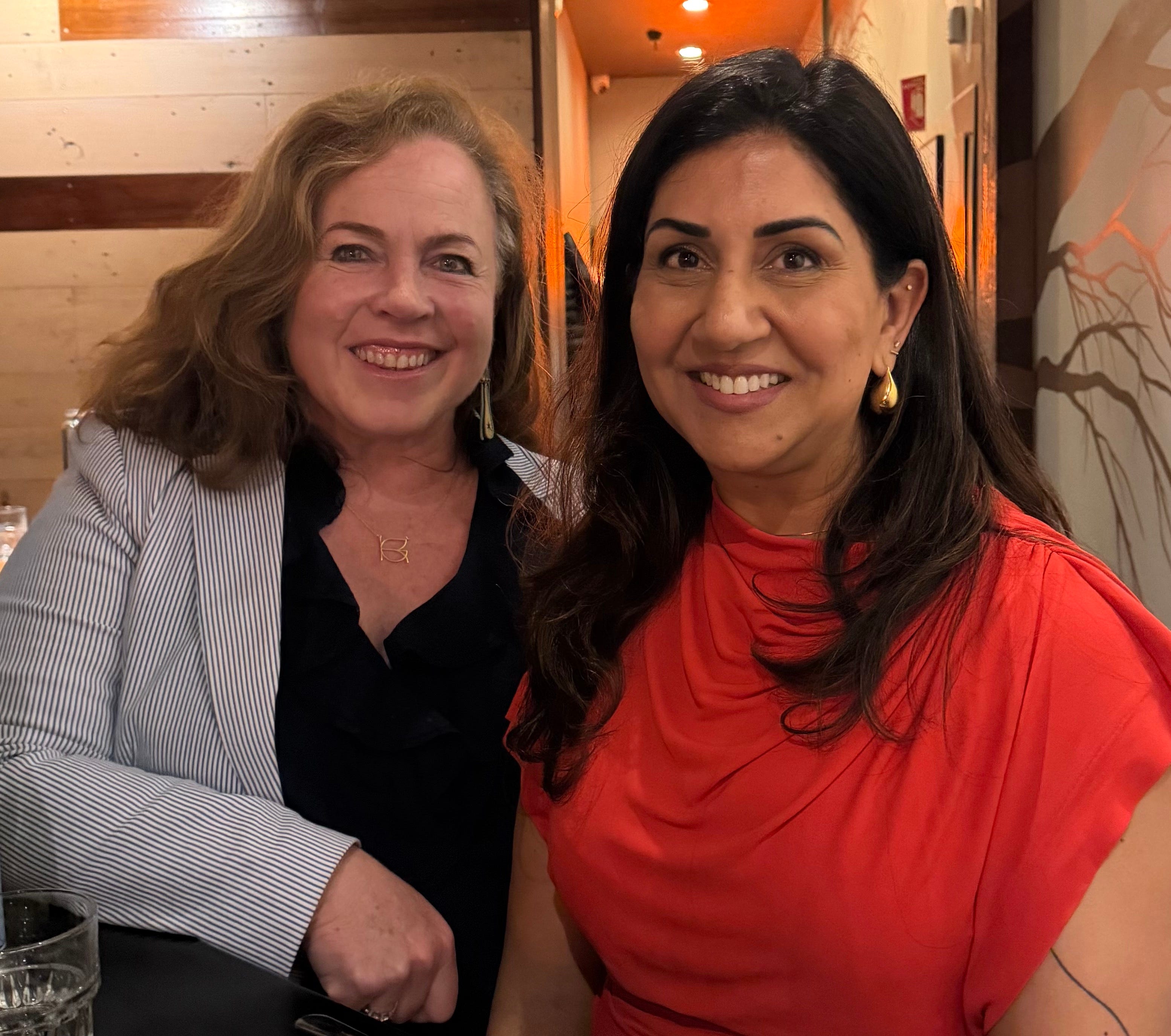
I’ve been lucky to call Nilofer Merchant a friend for well over 10 years, always admiring her grasp of the human part of business and how to unlock innovation. The picture above was shot in Los Gatos at the book launch party for “Our Best Work,” Nilofer’s 4th book. Guests flew in from all over the world to celebrate her/it — no surprise when you see the breadth of her bio:
Nilofer Merchant is the co-founder of Intangible Labs. She spent over 25 years leading tech companies (Apple, Autodesk, GoLive/Adobe) and personally launched over 100 products and services, netting $18 billion in revenues. She is ranked among the top 50 influential management thinkers in the world (one of her TED Talks has been referenced 300 million times).
After reading and digesting this amazing book, I did two things:
1). Gifted a copy to my son, Ben, just starting off on his corporate career
2). Interviewed Nilofer for my own readers (you!)
Ready? Here goes.
KG: The subtitle of OUR BEST WORK is “Break free from the 24 invisible norms that limit us.” My copywriter brain zeroes in on the heavy lifting of the word “invisible.” Norms are so pervasive they usually go undetected. How can we fix what we can’t see? Now that your book makes the invisible visible, how are leaders responding to it -- with surprise, relief, resistance?
NM: That’s the key word — keen eye. The response has been a mix of all three: surprise, relief, and yes, resistance. A retired SVP from one of the big chip companies wrote to say he now realizes that what he believed was world-class leadership had real blind spots — and he wishes he could have had this book decades earlier. Now he’s passing it to the students he mentors. A leader in Australia working with indigenous communities is using it to ask entirely new questions about what metrics even belong in their world. She’ll report back, she said. That’s the relief — people finally having language for something they felt but couldn’t name.
The resistance is real too. Some would rather have a book that says everything is basically fine and here’s how to optimize your way forward. I understand the appeal. But I finished writing this knowing two things: we can’t fix what we can’t name, and — especially now, when AI and quarterly results seem to dominate every conversation — what will actually create lasting value is what makes us irreducibly human. That’s not a soft idea. That’s the economic argument for transformation.
KG: Many of my readers work in creative fields. Which of the 24 norms do you feel is most important for them to break free of to do their best work?
NM: For creatives, I’d say the norm around personal branding — because it hits them hardest and they rarely see it coming. Creatives are told early: develop your voice, claim your niche, be findable, be consistent. And they pour themselves into it. But here’s what that process actually does — it flattens a complex human being into a single sellable narrative. Once you’re branded, you’re only as valuable as your continued usefulness to that brand. And usefulness has an expiration date.
Wendell Berry wrote that we’ve replaced the old market on which people were sold with a new market on which people sell themselves. That line hasn’t left me. Because what branding asks of us — the constant pitching, the self-packaging, the performing of a version of yourself — does something to the soul. Creatives feel this acutely. The work starts to serve the brand instead of the brand serving the work.
The alternative isn’t invisibility. It’s integrity. We don’t need to market ourselves — we need to be ourselves, and trust that the depth of that is what actually creates lasting value. That’s a harder sell than “optimize your LinkedIn.” But it’s the one worth making.
There’s more on that in Chapter 16, in a chapter entitled You Are Not For Sale.
KG: I love how you center joy in many of your chapters. That alone is a revelation -- that our best work should be joyful. As many companies begin to unhook from hierarchy, control and capitalism, how is joy showing up in their people and products?
NM: Let me start with what joy actually means, because the word has been so abused. Joy is not happiness theater. It’s not the ping-pong table, meditation classes, or a wellness stipend. In my framework, joy is closer to vitality — it’s evidence. It tells you whether a system is life-giving or life-draining. Generative or depletive. Whether people are becoming more fully themselves inside their work, or slowly disappearing into the machinery.
That distinction matters enormously for innovation. My theory—and remember, I’ve been an innovation expert for a very long time, and this is my fourth book—is that new ideas don’t emerge from control but from creativity. They emerge relationally—through curiosity, through the freedom to dissent, through people who feel alive enough and full of themselves to bring something original forward. There’s real neuroscience behind this. Barbara Fredrickson’s broaden-and-build research shows that positive emotional states expand cognitive range, creativity, and openness, while threat states do the opposite. So when I look at most workplaces, I see systems unintentionally engineered around oppression, and then leaders genuinely baffled about why originality has gone missing.
Fear narrows. Joy expands. That’s not sentiment. That’s structural.
Which brings me to what I think is the larger argument underneath this book. We are moving into an economy where the things that make us irreducibly human — intuition, care, imagination, dissent, courage, the capacity to connect — are precisely what AI cannot replicate. And those capacities only emerge fully when people feel fully alive to access them. Not just their logic. Not just their efficiency. The whole of their intelligence. Joy is the signal that the wholeness necessary for innovation is still intact.
So when I talk about aliveness at work, I’m not drifting into sentiment. I’m making an economic argument. A society that cannot produce joy from its work will eventually produce neither innovation nor freedom.
For me, it was a real joy to write this work, because I’m able to hold a vision that better, even the best work is possible. But it will take a real reimagination by many of us to build. Together.
KG: The chapter I underlined more than any other was chapter 13: “Don’t Mistake Paternalism for Leadership.” You describe the old model as one leader adapting to the follower (servant leadership). The new model is “many leaders adapting to the work” (situational leadership for modern work). Rather than asking “who’s the leader?” -- we should instead ask “what is needed now?” This seems like one of those shifts that people fear will slow down a central chain of command, but actually opens up true solutions and innovation. This chapter 13 can literally prevent the other chapter 13. How do you get “speed of business” people on board with situational leadership?
NM: I want to start with empathy for the speed-of-business leader, because they get misread. They’re not heartless beings who’ve decided that creativity and innovation don’t matter. They’re simply trying to solve a genuinely hard problem: markets shifting at an unprecedented pace. Not that long ago (within our work lifespan, Kat), companies used to be able to hold an advantage for decades; now, sustainable advantages are a thing of the past. So every leader is simply trying to keep up by doing more and faster. They can’t imagine how not to optimize for speed.
And what I want to ask them is this: in this time of deep uncertainty, what actually creates adaptive capacity?
And I mean something specific by that. Adaptive capacity isn’t agility in the Silicon Valley sense. It’s the ability to respond to the permanent absence of structural advantage — because that advantage is now temporary by definition — and be ready for what you can’t yet see coming. That’s a different kind of readiness than speed. Speed is motion. Adaptive capacity is intelligence.
Here’s where the AI data gets interesting. A recent management study found that AI helped a consulting company (BCG) work 25% faster, and have 12% more output — but got 19% of things wrong. AI gets you speed. But it cannot tell you which 19% is wrong before it scales. That’s the judgment problem. And judgment lives in people and their distinct perspectives. The person closest to the customer who notices something is off. In the team member who disagrees and doesn’t feel safe saying so. In the the cross-functional conversation that never happens because everyone is moving too fast to have it.
This is where situational leadership stops being philosophy and becomes an operational answer.
An aliveness-centered organization may look messier. More rough at the edges. But it learns faster. And in volatile environments, learning speed beats execution speed. Organizations can sprint directly off a cliff. Like Wile. E Coyote, going ever faster only to learn a beat too late, there’s no ground underneath them.
So I’m not asking the speed-of-business leader to slow down. I’m asking something that is both harder but far more useful: you don’t have enough intelligence in one room, one role, or one mind to navigate this era. And once leaders see that—really see it— aliveness stops being a soft idea. It becomes the way we build the next.
KG: Each of your chapters can be digested on its own, with the limiting norm and leading indicator listed right as the chapter kicks off, plus an innovation practice at the end. The coach in me immediately sees huge value in companies offering a book group/discussion each week that tackles one chapter. Is that in the works?
NM: You’re the second smartie pie person to ask me that, and my answer is... let’s do it. As I’ve written in prior books, the future is not created, the future is co-created. So, I’m ready to co-create that with you and yours.
What a wonderful place to end. The ball’s in your court, readers. Buy this book, share this book, host a book group at your workplace to make these 24 invisible norms visible. Our best work won’t happen without it.
Until next time, remember that creativity knows no bounds.